Album Review #1: Tim Hecker - "Radio Amor"
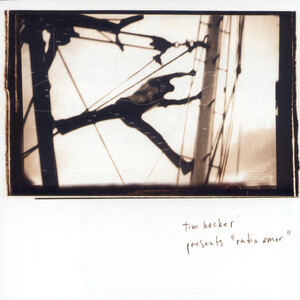
I can’t put this album down.
Brian Eno, a pioneer of ambient music, said the genre “must be as ignorable as it is interesting.” While that applies to Radio Amor, you’d be doing yourself a disservice by treating it as background noise. Tim Hecker managed to create an ambient album that conveys a certain mental image while still leaving its mood up to interpretation. That image is, of course, shrimping in the Caribbean. Specifically a fisherman named Jimmy who Hecker met in Honduras in the ’90s, who is presumably the titular “highwire shrimper” of the first and second tracks and the figure on the cover. You wouldn’t exactly expect that from an ambient album, now would you?
Radio Amor, released in 2003, is legendary ambient musician Tim Hecker’s second studio album, and is arguably his best. His debut, Haunt Me, Haunt Me Do It Again, was a glitchy, atmospheric, and cold-yet-warm album which Radio Amor only improves on. The album contains heavy use of shortwave radio recordings that add an element of nostalgia and warmth to the ambience.
The first track, “Song of the Highwire Shrimper”, begins with the crackle and whine of a radio in between stations, then introduces a synth reminiscent of Boards of Canada with an odd rhythm. The song’s elements shift in and out, with some beautiful lower tones occasionally appearing, layers of piano with a similarly irregular rhythm, and the song sometimes devolving into drones, then partially regaining its original structure. It ends with muffled, scrambled radio voices, then an airy synth tone comes in that leads us directly into “(They Call Me) Jimmy”. Does that name sound familiar?
This one makes me feel like I’m flying. It’s a favorite of many, and for good reason. This is such a memorable track. The aforementioned airy synth repeats through the entire song, with a melody that evokes a feeling of being high in the sky like the man on the cover. The synth tone roughens and smooths throughout the track, while sometimes being overtaken by the album’s signature noise. The song ends with the synth fighting for its life against the noise, until it all abruptly stops, except for some echoing voices that carry into “Spectral”.
The third track, meant to be named “Spectral Dialectics” before being crossed out on the CD’s liner notes, is an eight-minute journey through deep, low drones, crackling radio signals, distant voices, bursts of resonant and shimmering tones, and oscillating synths. These elements shift in and out throughout the track, before it all disappears and takes us to the emotional centerpiece of the album, “I’m Transmitting Tonight.”
This song is the album’s best by a long shot, at least in my opinion. Words could never do this song justice, but its admirers attempt to describe it anyway. One YouTube commenter says the song conjures the image of “a very lonely cold war spy in a foreign country sending a number station or something but doesn’t hear back from intel” in their head. I couldn’t have said it better myself. The song’s piano riff that repeats throughout carries a ton of emotional weight, and its long tails that sometimes shift up or down in pitch add a sense of progression to the song before the riff finally disappears. It’s simple, but it’s absolutely beautiful. We’re then left with more scrambled radio signals that start off “7000 Miles”.
This one’s pretty underrated. If you’ve ever heard Oneohtrix Point Never’s “Andro” off Replica (which is my 2nd favorite ambient album, only surpassed by Radio Amor), you might hear some resemblances. These two songs feel like cousins to me. Maybe I’m just making that up. Anyway, this is another one that feels like being high in the sky, and it’s sort of like a follow-up to the second track in that way. If “(They Call Me) Jimmy” is soaring, “7000 Miles” is hovering in the air above your ship and looking off into the distance at the sea.
“Shipyards of La Ceiba” is next. It’s the shortest on the album, maybe meant to be an interlude, and the most reminiscent of Hecker’s debut. It’s a piano-driven drone track with lots of small, glitchy moments. The Fennesz influence is strong on this one. It’s simple and short, but very memorable, and the album wouldn’t feel complete without it.
“Careless Whispers”. Who does Timmy H think he is, George Michael? This starts out as a calm yet surprisingly ominous drone song, with unintelligible radio voices and almost percussive glitches in the background. A melody eventually emerges for a short time about halfway through, then fades away soon after. The last 90 seconds or so bring to mind being abducted by aliens for whatever reason. This one’s sort of forgettable, but it still adds to the album.
“The Star Compass” feels like the previous track’s more hopeful and outgoing sibling. There’s a very pretty melody to cling onto this time, with washes of drones and noise occasionally overtaking it. This is another one of those tracks that evokes being out at sea in the fog (Ravedeath, 1972 reference), but I can’t really put my finger on why. That seems to be the theme of this album; being alone at sea, but not lonely. The waves and the mist are here to comfort you on your journey. God, I sound like an LLM. I’m basically a Pitchfork writer already. Maybe I should just retire. Anyway, next is “Azure Azure”, the longest track on the album.
In the beginning, we’re slowly faded into a quite beautiful and melancholic melody with radio chatter smeared throughout. Very contemplative. Nothing new so far though. It eventually gets a bit shoegazey and glitchy, which feels like the waves getting more intense to me. In the second part of the song at about the four-minute mark, the waves calm again and the melody dissolves into a drone that gives us a while to reflect on our journey through this album. Four whole minutes later, the earlier section’s crunch is applied to the drone, implying a sense of urgency again. The drone is then faded out, and we’re taken to the last track.
“Trade Winds, White Noise Heat”, as it’s written on the inside of the CD, is literally just a repetitive and melancholic chord progression with some radio noises for good measure. For four and a half minutes with hardly any variation. And it’s breathtaking. It’s one of Tim’s most popular tracks, and for good reason. It sounds boring, but I’m just unable to describe it. This is the song that clicked with me the least on my first listen, but now I find myself waiting for it during “Azure Azure”, even though that song is one of the best on this album. And just like that, we’re back to shore.
This album has been with me through a lot already. I listen to it any time I need to reset myself and feel a sense of familiarity. It’s so cold, yet so warm. It’s comforting despite its seemingly lonely atmosphere. It was the biggest influence on the creation of my most recent EP, and feels like a part of me at this point, despite only discovering Tim this year. It’s one of my favorite albums of all time.
See you later, Jimmy.
10/10
Favorite song: “I’m Transmitting Tonight”